2026-07-21
Gangnam Mastectomy and Reconstruction: Timing, Side Effects, and Management
Learn about the optimal timing for breast reconstruction after mastectomy, potential side effects, and essential management strategies. This guide covers immediate vs. delayed reconstruction, common complications like capsular contracture, and the importance of post-operative care and communication with your medical team for a successful recovery.

Gangnam Mastectomy and Reconstruction: Timing, Side Effects, and Management

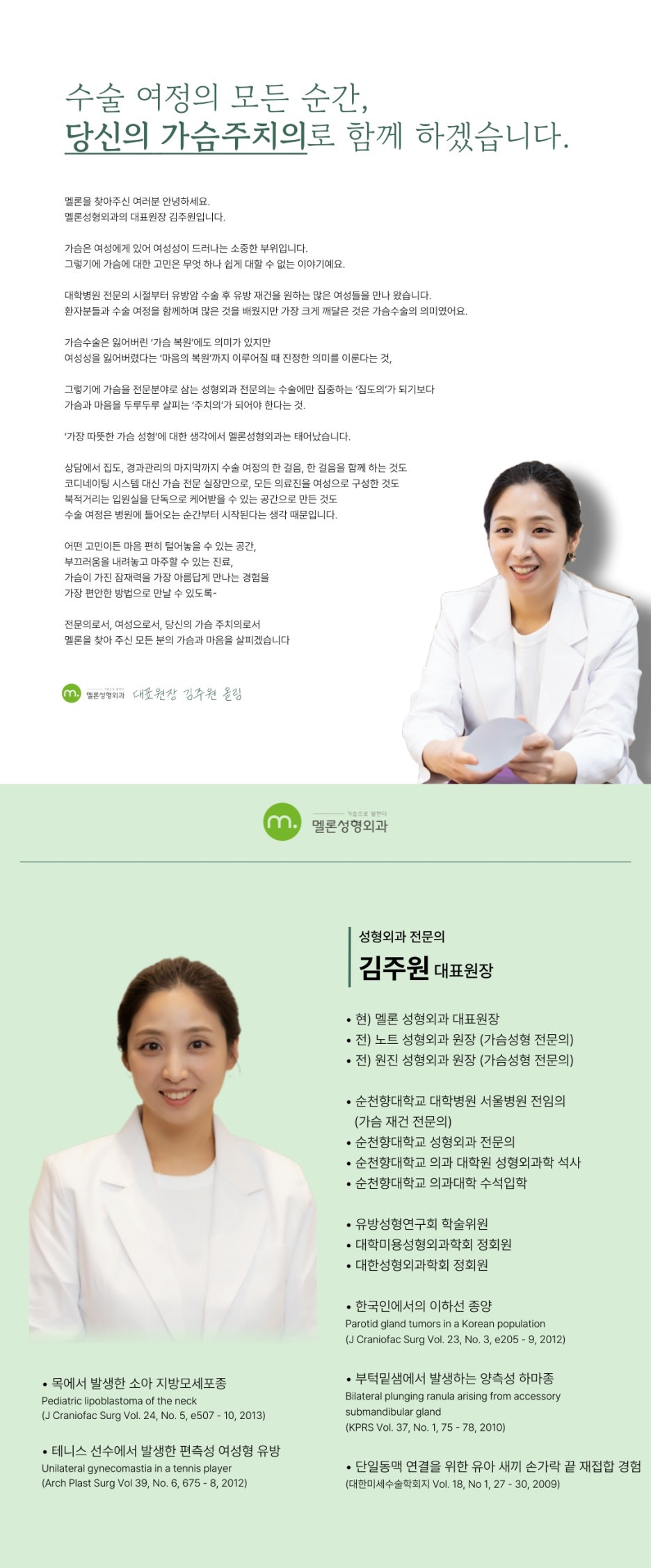
Hello. I am Dr. Joowon Kim, the chief representative director of Melon Plastic Surgery, your breast specialist.
The incidence of breast cancer among Korean women accounts for approximately 24.6% of all female cancers. This statistic indicates that about one in four women may suffer from breast cancer. Among those who suffer from breast cancer, there are often cases where they undergo a mastectomy.
While mastectomy is an unavoidable choice for cancer treatment, it often leaves a psychological sense of loss. Facing the visual reality of a lost breast can inevitably lead to a feeling of emptiness.
This feeling can persist even after cancer treatment is complete, and while those around may say it's fine because the treatment is over, for the individual, it can feel like an incomplete recovery.
‘When can I undergo reconstruction?’‘Will reconstruction cause cancer recurrence or side effects?’
Today, I will discuss the appropriate timing for reconstruction after mastectomy, potential side effects, and management methods. I hope this provides even a small amount of help to those considering breast reconstruction.
Breast Reconstruction After Mastectomy | The Process of Restoring Physical and Daily Life Loss
The post-operative difficulties experienced by those who have undergone a mastectomy are more arduous than expected.
This is not only because of the pulling sensation that can occur when moving the arm, but also because swelling due to lymph node dissection can make everyday movements difficult.
A stiff shoulder can make arm use less effortless than before, and dulled skin sensation can make the feeling of clothes uncomfortable.
These changes experienced after surgery not only cause daily inconvenience but also present difficulties in facing the fact that physical function and daily life have changed from before the surgery.
Those who experience such changes may avoid going out, and in severe cases, experience a decrease in self-confidence in social interactions.
Therefore, reconstruction should be viewed not only as a surgery to restore a lost breast but also as a process of healthily recovering the disrupted balance of daily life and mind.
Breast Reconstruction After Mastectomy | Surgical Timing for Satisfactory Results

If you are considering reconstruction, you are probably wondering about the ‘surgical timing’ – when is the best time to have the surgery?
‘How soon after a mastectomy can I have reconstruction?’‘Is reconstruction possible after treatment is complete?’
The timing of reconstruction can be broadly divided into two categories: ‘immediate reconstruction’ and ‘delayed reconstruction’.
‘Immediate reconstruction’ is a method of restoring the breast simultaneously with the mastectomy, which has the advantage of reducing the number of surgeries and simultaneously restoring the sense of loss.
‘Delayed reconstruction’ is performed when the tissues have stabilized after chemotherapy such as radiation therapy, and involves undergoing reconstruction after a recovery period following the mastectomy.
Of course, there are cases where reconstruction can be performed immediately after a mastectomy, but it is generally best to wait about 6 months after chemotherapy or radiation therapy is completed. We recommend proceeding after the body, including the excised tissue and skin, has fully recovered.
Ultimately, reconstruction requires a careful examination of each case, such as whether your breast tissue and body have recovered enough to undergo another surgery, and the surgical timing should be determined accordingly. This is because reconstruction can be the point at which daily life is restored and a new life begins.
Breast Reconstruction After Mastectomy | Side Effects of Reconstruction

While most people considering reconstruction approach it with hope, some also feel fear. This is due to concerns about side effects.
Having already gone through the difficult process of breast cancer, the possibility of facing another pain can be a great fear for the individual.
There are two surgical methods for reconstruction: ‘implant reconstruction’ using implants, and ‘autologous tissue reconstruction’ using the body's own tissues. There is a possibility of side effects regardless of the surgical method.
‘Implant reconstruction’ carries the possibility of a side effect called capsular contracture, and ‘autologous tissue reconstruction’, while not a side effect, can leave scars at the tissue harvesting site and, in some cases, may be accompanied by pain.
However, the risks or side effects that can occur in reconstruction can be managed through post-operative care, such as taking preventive medication and regular check-ups, and can be improved with correction or additional procedures if necessary. Therefore, sufficient communication with your medical team before and after surgery is paramount.
This is because by thoroughly discussing your physical condition, daily life, and fears before surgery, and sharing your recovery status, questions, and concerns after surgery, you can prepare for unforeseen circumstances and reduce the possibility of side effects or pain.
Breast Reconstruction After Mastectomy | Recovery Management and Trustworthy Choice

After undergoing reconstruction, a recovery period follows. The core of this recovery period lies in regaining not only breast stability but also life balance.
In the early stages after surgery, it is advisable to wear a functional bra to aid breast recovery, and to consistently continue scar management and skin moisturizing.
For arms with restricted movement, the range of motion should be restored according to the medical institution's guidance, and light stretching to prevent swelling and healthy lifestyle management should also be accompanied.
Don't forget to take care of your mind. If you have the will to care for yourself, support from those around you, and sufficient communication with your medical team, the sense of loss due to mastectomy can also be reconstructed.
Therefore, if you are considering breast reconstruction, it is good to consider an institution that will accompany you on your surgical journey. It is essential to confirm whether the surgeon who examines your condition and performs the surgery has extensive experience, and whether post-operative recovery management is systematically and meticulously carried out.
This is because when the three elements of the surgeon, medical staff, and your own management are well-aligned, the risk of side effects decreases, and the possibility of a healthy and beautiful outcome increases. Please remember that breast reconstruction is a ‘breast journey’ that reconstructs lost confidence and daily life.
Please consult us with any concerns about your breasts. Melon Plastic Surgery will wholeheartedly accompany each individual's breast journey.
Thank you.
Frequently Asked Questions
When is the best time to undergo breast reconstruction?
The timing of breast reconstruction is broadly divided into immediate reconstruction and delayed reconstruction. Immediate reconstruction is performed simultaneously with mastectomy, while delayed reconstruction is performed when tissues have stabilized after chemotherapy. It is generally recommended to wait about 6 months after chemotherapy.
What are the methods for breast reconstruction?
Breast reconstruction has two main methods: ‘implant reconstruction’ using implants and ‘autologous tissue reconstruction’ using the patient's own tissues. Each method has different advantages, disadvantages, and potential side effects.
What are the potential side effects after reconstruction?
With implant reconstruction, capsular contracture can occur, and with autologous tissue reconstruction, scars or pain may accompany the tissue harvesting site. These side effects can be managed with post-operative care and regular check-ups.
How should I manage my recovery after breast reconstruction?
In the early stages after surgery, consistent use of a functional bra, scar management, and skin moisturizing are important. Stretching to restore arm range of motion and healthy lifestyle management to prevent swelling are also crucial.
Does breast reconstruction help with psychological recovery?
Yes, breast reconstruction is not just about restoring a lost breast; it can be seen as a process of healthily recovering the disrupted balance of daily life and mind, including the physical functional loss from mastectomy and decreased self-confidence in social interactions.
Is communication with the medical team important during reconstruction?
Yes, it is very important. Thorough communication with your medical team before and after surgery to share your physical condition, fears, and recovery process can help you prepare for unforeseen circumstances and reduce the possibility of side effects.