2026-07-21
Breast Augmentation Results: Will Everyone Be Satisfied with Their Outcome?
Breast augmentation can be life-changing, but not everyone achieves their desired results. Factors like radiation therapy, previous fillers, or a suboptimal first surgery can impact satisfaction. Realistic expectations and thorough consultation are crucial for a successful outcome.
Breast Augmentation Results: Will Everyone Be Satisfied with Their Outcome?

Breast augmentation is a significant choice that can transform a person's confidence, life, and quality of living. However, it doesn't guarantee that everyone will achieve their desired results.
Sometimes, due to physical limitations or existing treatment history, the satisfaction with breast augmentation may not be as high as expected. Therefore, before deciding on surgery, it is crucial to set realistic expectations based on careful consideration and accurate information.
- Table of Contents -
1. For Breast Cancer Patients Who Have Undergone Radiation Therapy
2. If You Have Received Breast Filler Injections
3. If the First Surgery Was Inadequate
4. What to Consider Before Breast Augmentation?
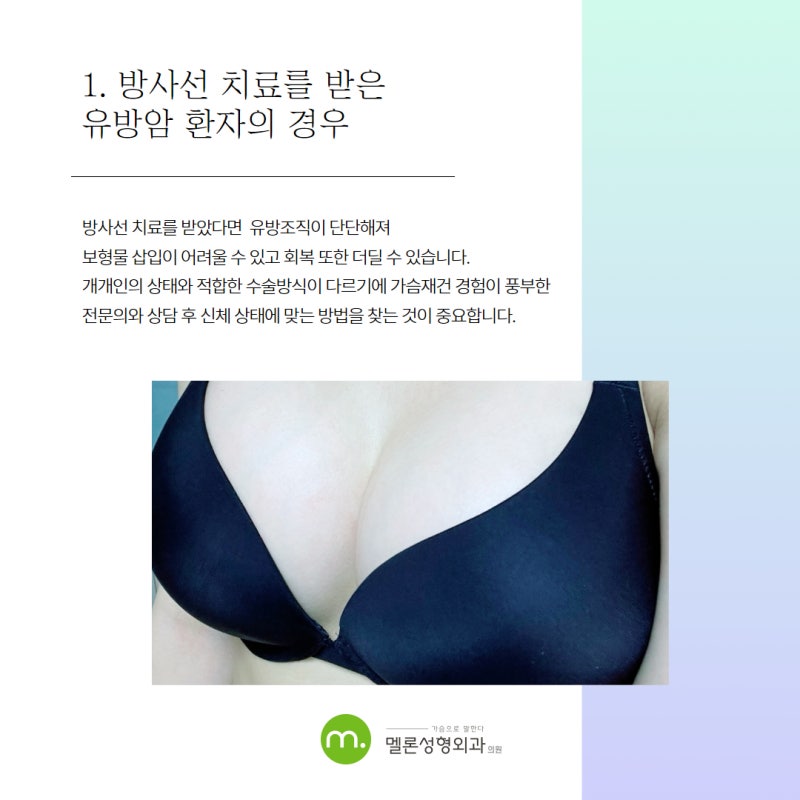
1. For Breast Cancer Patients Who Have Undergone Radiation Therapy
Many women who have overcome breast cancer consider breast reconstruction. However, if there is a history of radiation therapy, different considerations are necessary compared to standard breast augmentation.
Radiation therapy can cause fibrosis, which hardens breast tissue. In such cases, skin elasticity decreases, and the tissue does not stretch easily, making it difficult to achieve the desired expansion when inserting an implant. Furthermore, if blood circulation is not smooth after radiation therapy, it may affect the recovery speed, and the likelihood of capsular contracture (the hardening of tissue around the implant) after surgery may also increase.
What should be done in this case?
If there is a history of radiation therapy, the physical condition must be accurately assessed. If the skin tissue is too firm, it may be difficult to achieve the desired volume or shape with implant insertion alone. Therefore, it is important to have a thorough consultation with a specialist and medical staff to find the optimal method suited to your physical condition.
2. If You Have Received Breast Filler Injections

In the past, breast augmentation using fillers was popular because it offered a simple way to enlarge breasts without surgery. However, as time passed and various problems came to light, it is now rarely performed.
Breast fillers do not naturally absorb over time and can remain as small lumps within the tissue or spread between tissues. Such irregularly remaining fillers can increase the risk of infection when inserting an implant, and also increase the risk of bleeding during surgery. Moreover, if the filler has spread deep into the breast tissue, it can be difficult to remove completely, which may limit achieving the desired shape even with revision surgery.
What should be done in this case?
Before considering implant insertion, it is necessary to remove the filler as much as possible. It is safe to undergo tests to check how much filler remains, and if necessary, surgically remove the filler, observe the progress for a certain period, and then consider implant insertion. We recommend proceeding with this after a thorough consultation with medical staff.
3. If the First Surgery Was Inadequate
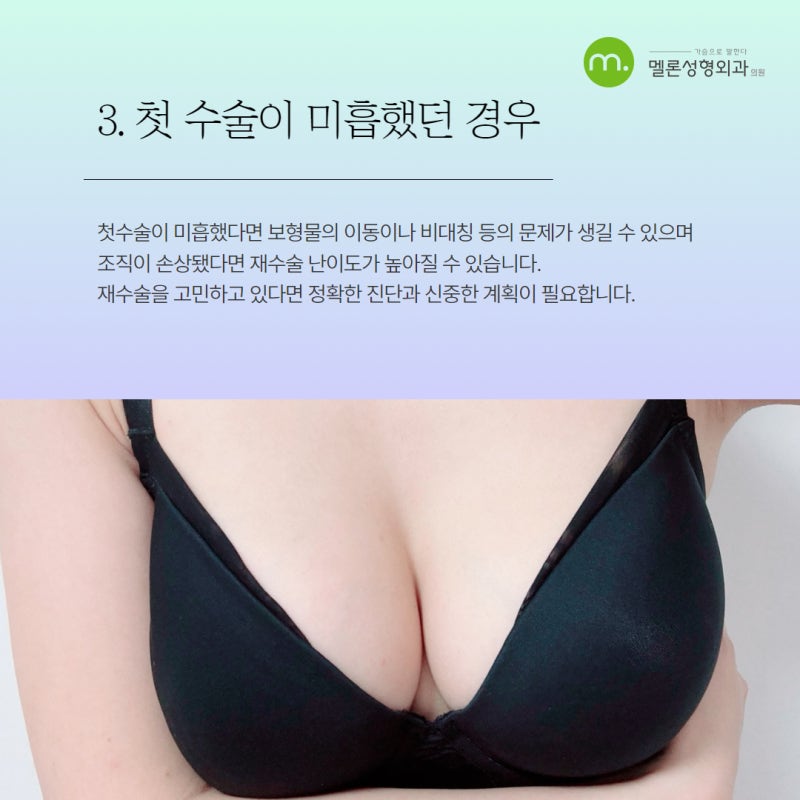
If the hospital and implant are not carefully chosen during the initial breast augmentation, dissatisfaction with the results may lead to considering revision surgery. If the first surgery was inadequate, the following problems may typically occur:
If the incision site or implant insertion position is inappropriate
→ The implant may move or new asymmetry may occur
Excessive pocket dissection (the process of creating space for the implant)
→ The implant is highly likely to shift from its position
If the implant selection was incorrect
→ If an excessively large implant was inserted, severe bottoming out or sagging may occur over time
The greater the problems from the first surgery, the more limitations there may be for revision surgery. If multiple surgeries have already been performed, the difficulty of revision surgery increases, and satisfaction after surgery is also likely to decrease.
What should be done in this case?
If problems occurred after the first surgery, it is important to first accurately analyze the current condition of the breast, the implant, and the tissue. If capsular contracture has occurred or tissue damage is severe, it may be necessary to combine additional corrective procedures rather than just implant replacement. Furthermore, revision surgery requires more caution than the first surgery, so thorough consultation with a specialist and a more detailed and systematic plan are necessary.
4. What to Consider Before Breast Augmentation?

In addition to the cases mentioned above, satisfaction with breast augmentation can vary depending on an individual's physical characteristics and previous treatment history.
- Before the first surgery, you must accurately understand your breast tissue and skin condition.
- Decisions should be made carefully, considering the effects of previous procedures (fillers, fat grafting, etc.).
- Choosing an excessively large size can lead to side effects, so it is important to select a size that considers body balance.
- It is crucial to achieve highly satisfactory results through sufficient consultation and planning during the first surgery.
Breast augmentation is not just a simple cosmetic surgery. It is a decision that deeply affects a person's body and mind, so it is most important to understand your physical characteristics and set realistic expectations. By finding the most appropriate method for you and carefully considering your options, you can achieve healthier and more confident beauty.


Frequently Asked Questions
Is breast augmentation possible after radiation therapy for breast cancer?
Yes, it is possible, but it requires different considerations than general breast augmentation. Radiation therapy can make breast tissue firm, making it difficult to expand when inserting implants, and increasing the possibility of capsular contracture. It is necessary to accurately evaluate your physical condition and consult sufficiently with a specialist to find the optimal method.
Is breast augmentation difficult if I have a history of breast filler procedures?
Yes, if you have a history of breast filler procedures, a filler removal process is necessary before implant insertion. Remaining fillers can increase the risk of infection and bleeding, and limit the desired shape during reoperation. It is safer to consider filler removal first after examination.
Is reoperation possible if the results of the first breast augmentation are not satisfactory?
Yes, reoperation can be considered. If the incision site, implant position, or size selection was inappropriate during the first surgery, problems such as asymmetry or sagging may occur. It is necessary to accurately analyze the current breast condition and establish a detailed plan with a specialist.
What should I consider before breast augmentation to achieve high satisfaction?
Before breast augmentation, you need to accurately understand your breast tissue and skin condition, and your history of previous procedures. It is important to choose an implant size that is not excessive and considers body balance, and you can achieve satisfactory results through sufficient consultation and systematic planning.
How should I choose the implant size for breast augmentation?
It is important to choose the implant size considering body balance. Choosing an excessively large implant can lead to side effects such as severe bottoming out or sagging over time. You need to understand your physical characteristics and set realistic expectations.