2026-07-21
Gangnam Breast Lift | Causes of Breast Sagging, Choose Surgery Carefully
Discover the causes of breast sagging and how breast lift surgery can help restore a firm, youthful contour. Learn about different surgical techniques and the importance of careful consideration.
Gangnam Breast Lift | Causes of Breast Sagging, Choose Surgery Carefully
Have you ever looked in the mirror and noticed changes in your breasts that weren't there before?
Volume that seems to have dropped an inch,
A line that doesn't perk up even with a bra on,
Even breast skin that feels wrinkled –
While these changes in the breasts are natural phenomena experienced after childbirth, breastfeeding, or with age, it's understandable to feel unsettled when they happen to your own body.
Especially as seasons with lighter clothing, like summer, approach, concerns about body shape becoming more prominent can arise. This is because breast sagging is connected to a woman's self-esteem and quality of life.
Many people are now considering ‘breast lift surgery’ as a solution. Today, we'll delve into what breast lift surgery is, when it's needed, and how it's performed.
What is Breast Lift Surgery?
Breast lift surgery is a procedure that elevates sagging breasts to restore a firmer and smoother contour.
Breasts, like skin, are affected by time. As elasticity decreases, the tissues that support the breasts succumb to gravity and sag downwards.
Particularly after childbirth and breastfeeding, a reduction in glandular tissue often leaves only stretched skin, making the changes visibly apparent. In such cases, achieving desired results with breast augmentation alone, which only increases breast volume, can be difficult, necessitating a lift procedure to pull up the sagging skin and tissue.
Breast lift surgery is a procedure that excises and lifts sagging skin, but it also requires precise techniques to adjust the position of the nipple and areola to a more ideal location and to reposition the breast tissue.
Therefore, a thorough understanding of the individual's body type, skin condition, and degree of sagging before surgery, followed by a customized plan, is essential to achieve natural and harmonious results.
Stages of Breast Sagging and Self-Diagnosis Methods
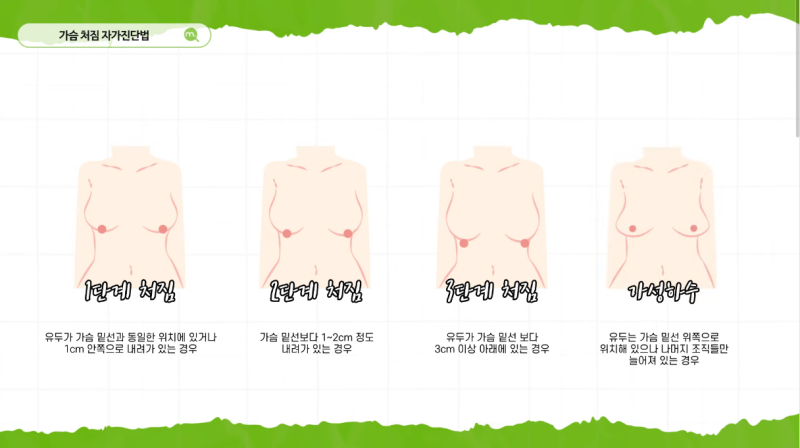
Breast sagging can be assessed based on the position of the nipple. Ideally, the nipple should be approximately 4-5 cm above the inframammary fold (breast crease), but it gradually descends with age, childbirth, or breastfeeding.
Stage 1 sagging is when the nipple is at or within 1 cm below the inframammary fold,
Stage 2 sagging is about 1-2 cm below the inframammary fold,
Stage 3 sagging refers to cases where it has descended 3 cm or more below that.
In addition, there is also a ‘pseudoptosis’ form where the nipple is in an ideal position but only the breast volume sags downwards. While self-diagnosis can help understand the general condition, it's best to confirm a more accurate diagnosis and whether surgery is needed through consultation with a specialist. Since the surgical method and incision range vary depending on the degree of sagging, accurately understanding your current condition is paramount.
Surgical Methods Varying by Incision Type
Breast lift surgery employs different incision methods depending on the stage of sagging.
For relatively mild Stage 1 sagging, the ‘periareolar incision method’ is used, which involves a circular incision around the areola to remove some skin and lift it. The scar is hidden by the areolar border, making it less noticeable, and recovery is relatively quick.
However, for moderate sagging of Stage 2 or higher, a vertical incision is necessary. This method adds a single vertical incision below the areola to effectively pull up and center the stretched skin.
For the most severe cases of Stage 3 or higher, an ‘inverted T-incision method’ (or anchor incision) is applied, which includes the areola, a vertical incision, and an incision along the inframammary fold. While the lifting effect is greatest due to the larger area being pulled, it's important to consider that a scar may remain.
The incision method should not be determined solely by the degree of sagging, but by considering skin thickness, healing ability, and scar response. Therefore, thorough consultation with medical staff and meticulous guidance are essential.
Breast Lift Surgery: Lifting Not Just Your Shape, But Your Self-Esteem Too
Breast lift surgery is often seen merely as a procedure to elevate sagging breasts. However, this surgery is also deeply connected to psychological recovery. For women, breasts are an important body part linked to their identity. If you've experienced lowered self-esteem when choosing clothes or standing in front of a mirror due to a breast shape that's not what it used to be, then lifting your spirits might be the true value of this surgery.
Even if you've lost weight through dieting but your breast line has sagged, a lift can help. Restoring breast elasticity can also improve overall body proportions, and confidence can naturally be regained. Therefore, you can consider breast lift surgery as a treatment that enhances your quality of life.
Wise Decisions, Careful Hospital Selection is Crucial
Breast lift surgery is a procedure with significant individual differences in incision range, scar response, and recovery speed.
Therefore, it's paramount to have a sufficiently thorough consultation before surgery and to create a plan tailored to your body's condition. As it's a surgery involving several incisions, post-operative recovery management is crucial, including refraining from alcohol and smoking for a certain period, and avoiding strenuous activities. In some cases, supplementary care like laser treatment may be combined. The recovery process after surgery is as important as the surgery itself, so it's best to decide on surgery when you are fully prepared.
Surgical results can vary depending on the medical team's experience, the surgical plan, and the patient's will to recover and manage. Even if the same surgery is performed, the results are not necessarily identical. Therefore, it's essential to take the time to carefully consider whether the surgery is truly necessary for you and what the surgical method will be. We recommend thoroughly envisioning the changes after surgery and making a careful decision.
Frequently Asked Questions
Why do breasts sag?
Breast sagging is a natural phenomenon experienced after childbirth and breastfeeding, or with age. Particularly after childbirth and breastfeeding, the glandular tissue often decreases, leaving only stretched skin, which can make sagging more prominent.
What kind of surgery is a breast lift?
Breast lift surgery is a procedure that elevates sagging breasts to restore a firmer and smoother contour. It requires precise techniques to adjust the position of the nipple and areola to an ideal location and to reposition the breast tissue.
How are the stages of breast sagging diagnosed?
Breast sagging can be assessed based on the position of the nipple. If the nipple is at or within 1 cm below the inframammary fold, it's Stage 1; 1-2 cm below, Stage 2; and 3 cm or more below, Stage 3.
How do the incision methods for breast lift surgery vary depending on the degree of sagging?
Yes, the incision method varies depending on the degree of sagging. For Stage 1 sagging, a periareolar incision method (circular incision around the areola) is used. For Stage 2 or higher, a vertical incision is added below the areola. For the most severe Stage 3 or higher, an inverted T-incision method, which includes the areola, a vertical incision, and an incision along the inframammary fold, is applied.
How should I manage recovery after breast lift surgery?
After surgery, it's important to refrain from alcohol and smoking for a certain period and avoid strenuous activities. In some cases, supplementary care like laser treatment may be combined, and sufficient will to recover and proper management significantly impact the surgical results.