2026-07-21
Gangnam Breast Cancer Breast Reconstruction Review? Exploring Surgical Methods, Effects, and Real Cases
Explore breast reconstruction after mastectomy in Gangnam. This article covers surgical methods, effects, and real patient cases, offering hope and guidance for those considering the procedure.

Gangnam Breast Cancer Breast Reconstruction Review? Exploring Surgical Methods, Effects, and Real Cases

Hello. I'm Dr. Kim Joo-won, the chief director of Melon Plastic Surgery, your breast specialist who understands your breast concerns.
Breast cancer can sometimes be cured with chemotherapy, such as radiation therapy, and surgery, but in some cases, a mastectomy is performed. Although it's a surgery for complete recovery from the disease, the decision to undergo a mastectomy as a woman is inevitably painful.
Therefore, even after undergoing a mastectomy and overcoming the disease, the empty space where the breast once was can feel like a bruise, and discomfort may arise in situations where the chest is exposed.
In fact, looking at cases of mastectomy, many individuals, despite showing great courage in fighting the disease, experience restrictions on going to places where their chest might be exposed.
The sadness of having gone through such a major event only to find one's freedom restricted—I believe this feeling is shared not only by me but also by many who are considering breast reconstruction.
‘Will reconstruction make me feel like I did before?’ ‘I can't get used to the feeling of not having a breast.’
Today, I'll be discussing breast reconstruction. I want to show you the process of regaining lost confidence through actual breast reconstruction cases. I hope this will be of some help, however small, to anyone considering reconstruction after a mastectomy.
Breast Reconstruction | Surgical Timing and Methods
Breast reconstruction is a surgery to restore the shape of the breast after a total or partial mastectomy during breast cancer treatment.
From a surgical perspective, it's a procedure to restore a lost breast, but from a broader perspective, it's also a process of rebalancing the body that has changed during the fight against cancer and restoring daily life that has become uncomfortable.
Reconstruction is categorized not only by surgical method but also by surgical timing. Based on timing, there are two types: immediate reconstruction and delayed reconstruction.
Immediate reconstruction, as the name suggests, is performed ‘immediately,’ concurrently with the breast cancer resection. Delayed reconstruction is performed after cancer treatment is completed. I often get asked when the best time for surgery is. There is no set ‘better’ time for surgery.
The most appropriate time for surgery is when the burden on the body can be minimized, and a positive outcome can be envisioned. To determine this timing, a thorough assessment of the current physical and mental state must precede the decision.
Surgical methods are also divided into two types: reconstruction using implants and reconstruction using autologous tissue.
‘Implant reconstruction,’ which involves inserting implants, has the advantages of faster recovery and the ability to achieve a shape close to what is desired. It is chosen by those who wish for a harmonious restoration of their breasts.
‘Autologous tissue reconstruction,’ which involves harvesting tissue from other parts of the body such as the back or abdomen for the surgery, has the advantage of looking more natural in terms of breast texture and shape because it uses the body's own tissue.
It's important to note that the surgical method can vary depending on the case. Breast reconstruction requires a thorough review of the patient's history during cancer treatment, and if radiation therapy has been received, the skin condition must be checked to determine the appropriate approach.
This is why communication during the breast reconstruction journey needs to take sufficient time. By sharing and examining everything from the history of the illness and treatment to the current physical and mental state, we can find a direction that brings comfort to both body and mind, and plan for good results.
Patients seeking breast reconstruction are usually highly motivated for restoration, so most cases are proactive about reconstruction. However, if painful memories remain from the fight against cancer, they may adopt a more passive attitude compared to their desire.
This is because for those who have experienced breast cancer, reconstructive surgery can be another medical process. If you desire breast reconstruction but feel psychological resistance, please remember that the surgical journey, from communication to surgery and recovery management, is not a process of dredging up painful memories but one of healing.
Breast Reconstruction Case | Reconstruction including the left breast after total mastectomy
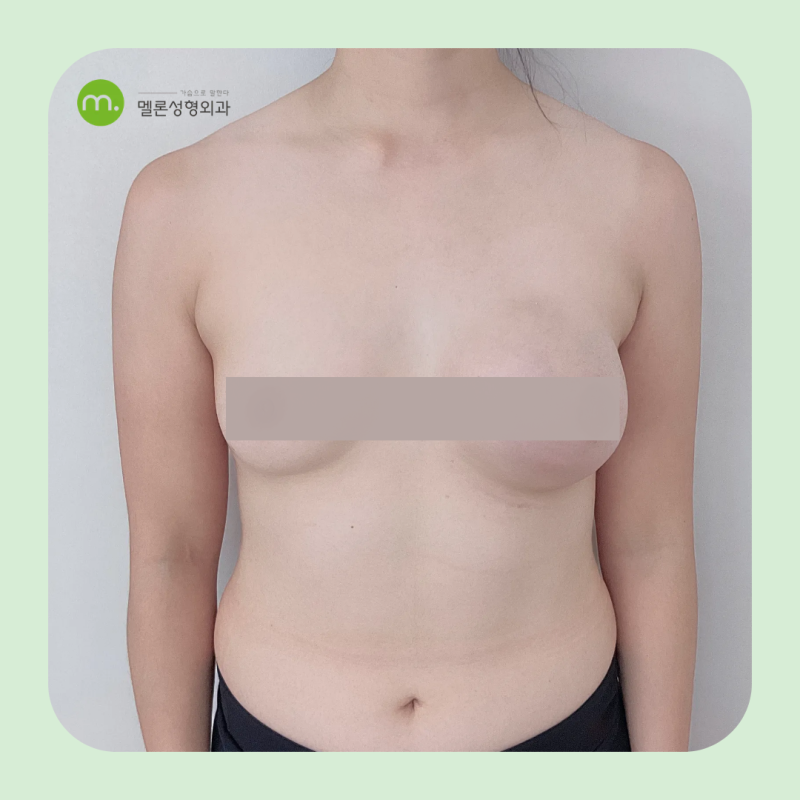
Let's briefly look at an actual reconstruction case performed at Melon. This case involved breast reconstruction after a total mastectomy of the left breast.
The patient had maintained an expander in her left breast, which had caused changes in skin color and condition. After thoroughly examining the skin and tissue condition, breast reconstruction was performed using implants.
As mentioned earlier, implant reconstruction allows for some adjustment of the desired shape and size, and this case is an example of that.
A 320cc implant was inserted into the right breast, and a larger 500cc implant was inserted into the left breast, which had undergone a total mastectomy, to design a surgery that would naturally harmonize the volume and body balance of both sides.


Above are the appearances 3 months and 6 months after breast reconstruction surgery.
Because the entire surgical journey, including post-operative recovery management, was meticulously carried out, the breast line and volume were stably restored. However, what brought even greater joy to the patient was the natural return of her skin color.
Breast Reconstruction Case | Reconstruction including the right breast after partial mastectomy
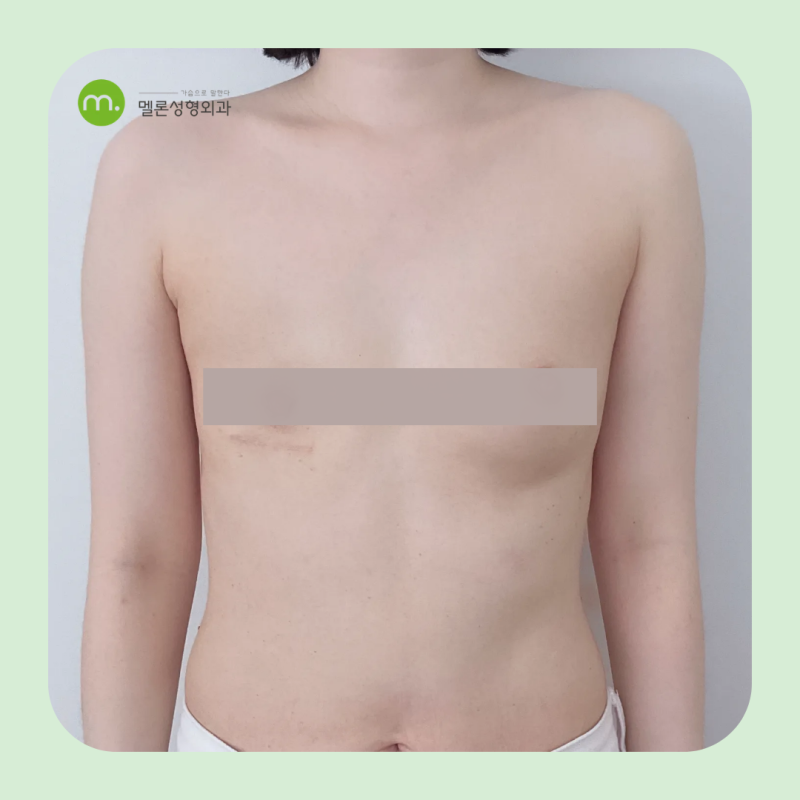
This time, it's a reconstruction case after a partial mastectomy.
About 9 months after undergoing a partial mastectomy of the right breast, reconstruction surgery was performed at Melon. To determine the most appropriate timing for the reconstruction surgery, two pre-operative consultations were held to assess the recovery status.
In cases of partial mastectomy, a higher proportion of breast tissue remains compared to total mastectomy. It's necessary to subtly adjust the balance of height, size, and symmetry, and to control the overall balance, considering the density and elasticity of the remaining tissue.
In this case, the patient had naturally small breasts and a significant sense of loss due to the resection. Therefore, the surgical direction was set to add a change in volume to the breast restoration and to simultaneously address the sense of loss.
Due to the partial mastectomy, there was a depression in the right breast and asymmetry, so implant reconstruction was performed to achieve the most aesthetically pleasing volume balance possible.
A 375cc implant was inserted into the right breast, where the partial mastectomy was performed, and a 260cc implant into the left breast, which naturally compensated for the disrupted symmetry and created a fuller volume.
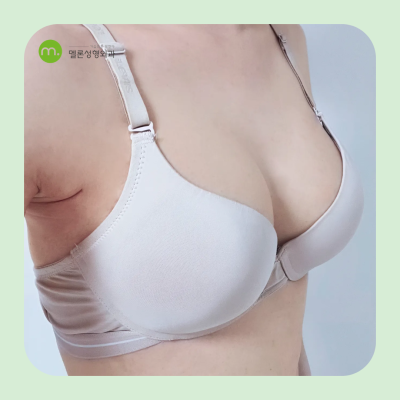

These are the appearances at 1 month and 3 months post-surgery.
The patient's satisfaction was high due to the good balance between both breasts. The satisfaction was even greater because when wearing a bra, her breasts appeared full without any traces of the mastectomy.
Breast Reconstruction | A Healing Process That Also Restores Lost Daily Life

Breast reconstruction is not a surgery that ends with the operation itself.
It requires a recovery period for the reconstructed breast to settle stably and for body movements to become comfortable. For those who have undergone breast reconstruction, the recovery period is significant because it also involves the restoration of daily life.
According to the medical institution's guidelines, after a certain point post-surgery, one can try visiting places previously avoided during the treatment period, such as saunas and swimming pools, and wear regular bras, bikinis, or tight-fitting clothes that adhere closely to the chest.
For this, post-operative recovery management is paramount. It's crucial to comprehensively manage the reconstructed breast, including skin, sensation, scars, and shape, and to meticulously check the condition at each stage through follow-up care directly supervised by the attending physician.
Preparation for emergency situations at night is also necessary. Melon Plastic Surgery operates a 9.9 emergency call service to prepare for unexpected situations in the middle of the night.
Those considering breast reconstruction have different types of concerns and depths of worry, as their experiences during cancer treatment vary. Whatever your condition or concern, if you have any questions about your breasts, please feel free to consult with your doctor.
Melon Plastic Surgery will accompany you through every step of your breast journey to ensure your current worries lead to a comfortable recovery.
Thank you.
Frequently Asked Questions
When is the best time to undergo breast reconstruction surgery?
There is no fixed 'best time' for breast reconstruction surgery. The ideal time is when the burden on the body is minimized and positive results can be achieved, which should be decided after considering your current physical and mental state. There are two main types: immediate reconstruction, performed simultaneously with breast cancer removal, and delayed reconstruction, performed after cancer treatment.
What surgical methods are available for breast reconstruction?
Breast reconstruction surgery is broadly divided into two methods. Implant-based reconstruction, which involves inserting implants, offers faster recovery and allows for a shape close to what is desired. Autologous tissue reconstruction, which involves taking tissue from the back or abdomen, has the advantage of natural feel and form. The most suitable method may vary depending on the patient's condition.
Why is post-operative recovery management important after breast reconstruction?
Yes, post-operative recovery management is very important after breast reconstruction. This is to help the reconstructed breast settle stably and to ensure comfortable body movement. Following medical institution guidelines, management for daily recovery such as using saunas, swimming pools, or wearing regular bras is necessary, and regular follow-ups with your surgeon are crucial.
Can breast reconstruction be performed simultaneously with breast cancer removal?
Yes, breast reconstruction surgery can be performed simultaneously with breast cancer removal. This is called 'immediate reconstruction.' There is also 'delayed reconstruction,' which is performed after cancer treatment is completed, so it is important to determine the most appropriate timing through sufficient consultation with the medical team and considering the patient's condition.
How is the size of the implant determined for breast reconstruction?
The implant size is determined by considering the patient's body balance and desired shape. In actual cases, when reconstructing after a total mastectomy on one side, a larger implant was inserted to balance with the opposite breast, harmoniously designing the left and right volume and body balance. A customized plan is developed through thorough consultation.
Is psychological healing also possible after breast reconstruction?
Yes, breast reconstruction is not only a physical restoration but also a process of psychological healing. While some may hesitate to undergo reconstruction due to painful memories or feelings of loss from the breast cancer journey, the entire process, from communication to surgery and recovery management, can help heal emotional wounds and regain lost confidence.