2026-11-05
Gangnam Breast Reconstruction After Cancer Treatment: University Hospital or Local Clinic, Which Is Better?
University hospitals time reconstruction around cancer treatment, while local clinics focus on what is achievable and aesthetic results. The better choice depends on your situation.
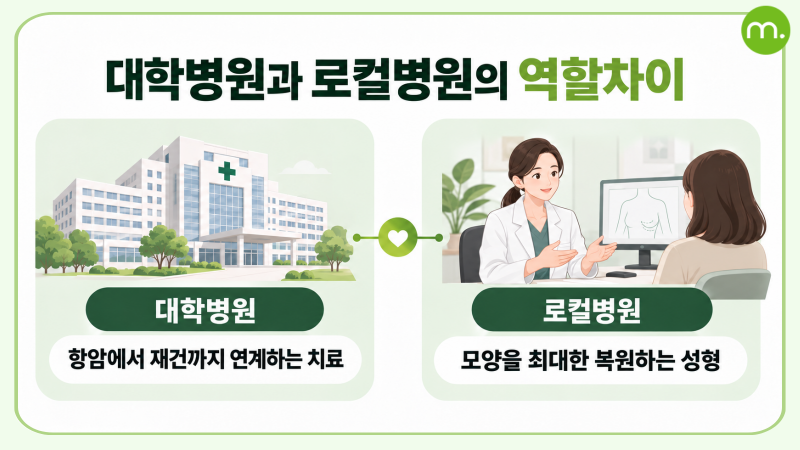

I had my cancer treatment at a university hospital, so isn't it better to have reconstruction there too? Gangnam breast reconstruction
This is a question that family members and friends of someone preparing for reconstruction often ask.
Patients often hear about it from fellow patients or look it up in online communities, so many already have a fair understanding and a surgical plan in place.
University hospitals and local clinics have clearly different strengths. That is why choosing a reconstruction provider is less about which one is better and more about which one suits you.
I have performed reconstructive surgery at a university hospital, and I currently do so at a local clinic, so I can speak more clearly on this topic today.
‘University Hospitals vs. Local Clinics: What Is the Difference?’
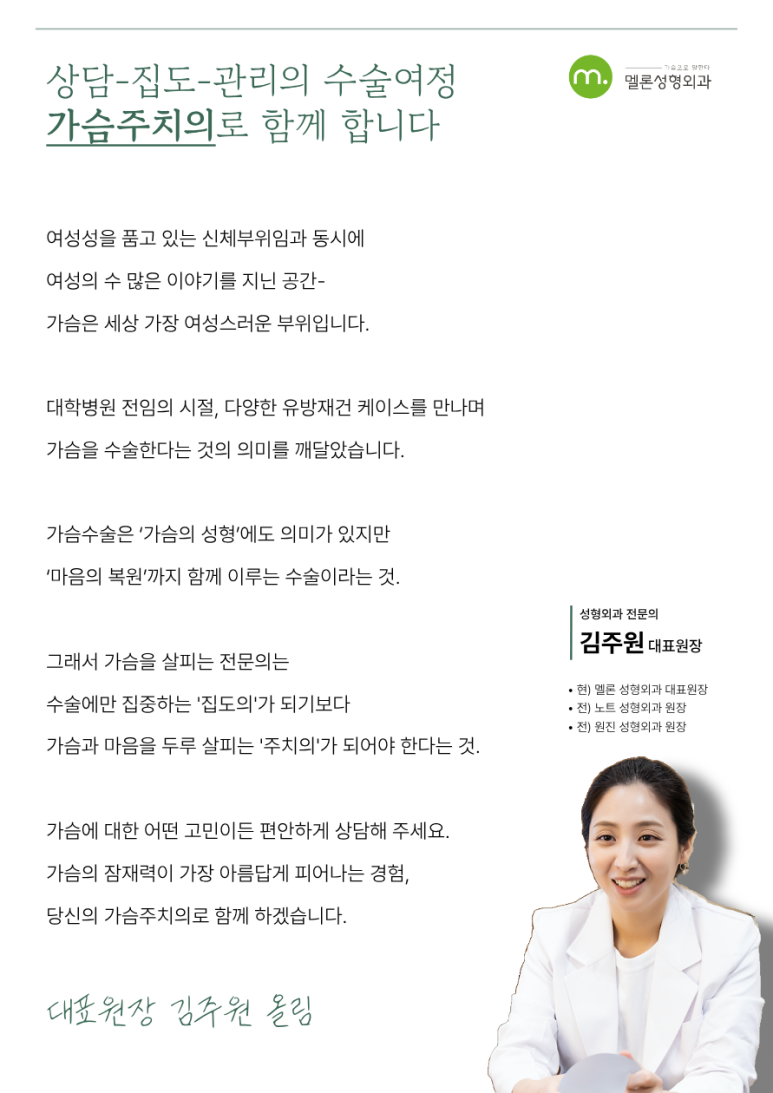
I am Kim Ju-won, Chief Director of Melon Plastic Surgery, your breast primary care doctor who finds solutions.
Breast Reconstruction | University Hospitals and Local Clinics Play Different Roles, Gangnam Breast Reconstruction
A university hospital views reconstruction from the perspective of cancer treatment. It approaches the process as one cycle that runs from cancer treatment through reconstruction.
Because it works closely with breast surgery and other departments that handle cancer treatment, it carefully coordinates the timing of treatment and reconstruction based on the stage and condition of the cancer. This includes how far the cancer has progressed, whether resection is needed, whether radiation therapy is required, and whether chemotherapy is necessary.
Immediate emergency response is another advantage. Although emergencies are rare, patients often feel reassured by the infrastructure of a large hospital.
A local clinic is a plastic surgery practice, so it views reconstruction from an aesthetic standpoint. It focuses on how much reconstruction is achievable and how beautifully the breast can be restored.
It carefully examines the factors that form the basis of reconstructive surgery, such as how much tissue remains after resection, or the condition of the tissue and blood vessels after radiation therapy. This helps gauge the extent of reconstruction possible and also confirms whether your current condition can withstand the surgery.
Postoperative recovery care also focuses on stabilizing the shape of the reconstructed breast.
As plastic surgery practices, local clinics specialize in breast procedures, and their extensive case experience is a key advantage.
Breast Reconstruction | The Reconstruction Methods Are the Same, Gangnam Breast Reconstruction
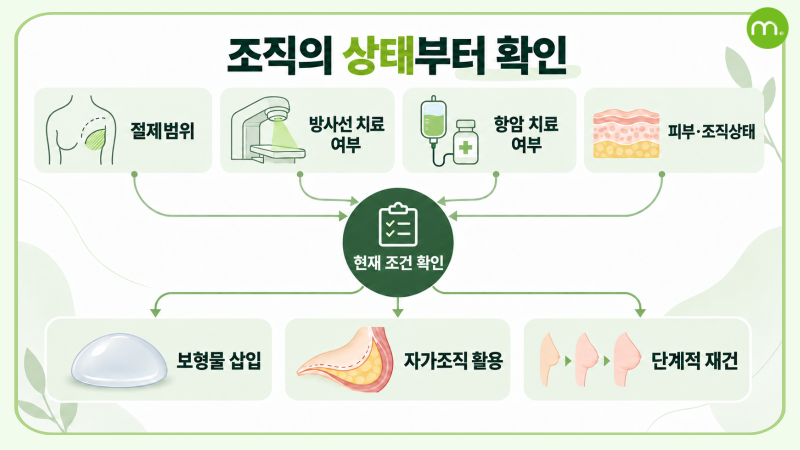
The surgical methods for reconstructing the breast are no different between university hospitals and local clinics.
There are three main types of breast reconstruction: inserting an implant, transferring your own tissue, and inserting an implant after expanding the skin lost to mastectomy with a tissue expander.
Implant reconstruction restores breast volume and shape with an implant. Surgery time and initial recovery are relatively short, but capsular contracture, in which the tissue around the implant hardens, can occur. The risk is higher after radiation therapy. In the long run, it is also wise to keep in mind that the implant may need to be replaced.
Autologous tissue reconstruction, as the name suggests, uses your own body tissue to rebuild the breast. Skin and fat are taken from areas such as the back or abdomen to restore the lost breast shape.
After total mastectomy, the goal is to ‘create’ volume and contour. After partial mastectomy, the approach is less about creating and more about ‘filling in’ areas that have become hollow or deficient. The tissue used also varies depending on the type of prior resection.
Autologous reconstruction offers a more natural shape and feel. Its drawbacks are longer surgery and recovery times, and scarring at the donor site where the tissue was removed.
Staged reconstruction divides the surgery into several stages. A tissue expander is first inserted to gradually stretch the lacking skin tissue. Once the expander is removed, a second surgery places an implant.
This approach may be considered if the remaining tissue is severely insufficient or if radiation therapy has left the tissue significantly hardened. It creates room in the tissue gradually, but it requires an additional surgery and regular clinic visits to inflate the expander, which can be inconvenient.
Think about what matters most to you, and you will likely find the answer to which surgery you want. Consult with a doctor to check your condition and physical factors, and confirm whether the surgery you want is possible.
Gangnam Breast Reconstruction | Differences in Postoperative Care
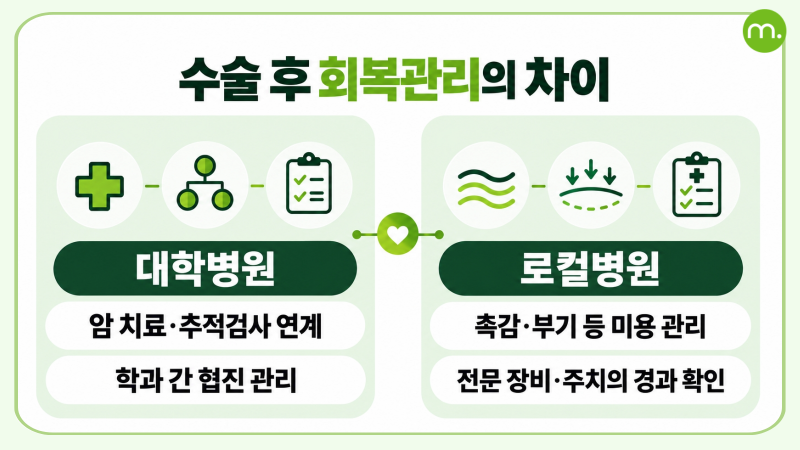
University hospitals and local clinics also differ in postoperative recovery care.
At a university hospital, reconstruction patients can relatively easily receive coordinated care with departments such as breast surgery and oncology for cancer treatment and follow-up testing, alongside recovery management. As mentioned earlier, one of the biggest strengths of a university hospital is its infrastructure, and that advantage also applies to postoperative care.
Local clinics are plastic surgery practices focused on aesthetics, so their postoperative care also centers on appearance. They stabilize the breast after surgery using specialized treatment equipment, such as devices that help soften firmness and reduce swelling.
At Melon, I personally check each patient's progress at every visit. Patients often tell me that being able to easily ask questions and get answers gives them emotional reassurance.
Gangnam Breast Reconstruction | Check Everything, from Before Surgery to Postoperative Recovery Care
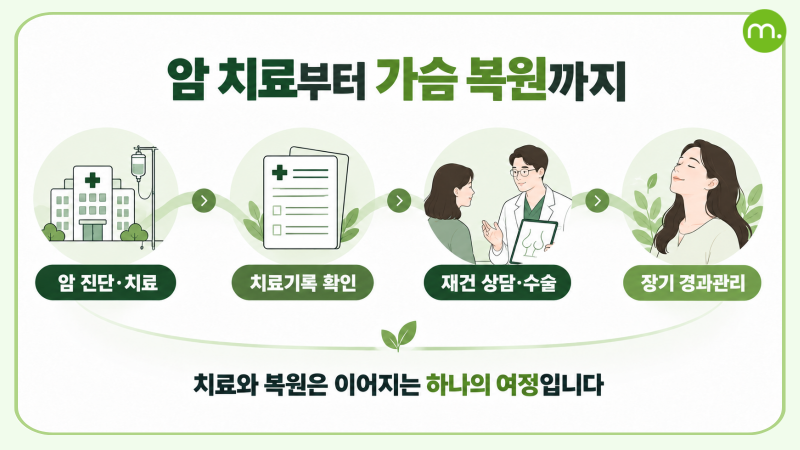
Reading online reviews of breast reconstruction can help you understand the surgical process. However, it is risky to look only at before-and-after photos and assume you will get the same results. Every body is different, so even with the same treatment, the process and outcome can vary. For example, even when the cancer type, stage, and size are the same and the same amount of radiation is given, the degree of fibrosis can differ. Because the chest conditions for reconstruction differ, the extent of skin and tissue restoration and the speed of recovery can vary even with the same surgical method.
Before surgery, review with your surgeon your specific conditions, the maximum possible outcome given those conditions, and any risks involved.
Breast reconstruction is a surgery that restores, as far as possible, a breast whose shape has changed due to illness. Please keep in mind that it does not return the breast to exactly how it was before.

Breast cancer reconstruction is not a process separate from cancer treatment.
I believe that only once your everyday life is restored, even to some degree, do you gradually begin to let go of what cancer took from you.
That is why my personal goal is always to go beyond the breast and help restore everyday life.
If you are considering breast reconstruction, please talk with us.
We will be with you through every step of your surgical journey.
Thank you.
#Melon #MelonPlasticSurgery #MelonBreastSurgery #MelonBreastReconstruction #MelonBreastDoctor #KimJuwon #DrKimJuwon #GangnamBreastReconstruction #GangnamBreastReconstructionClinic #BreastReconstruction #BreastReconstructionProcedure #BreastReconstructionSurgery #BreastCancerReconstruction #BreastReconstructionPlasticSurgery #ReconstructionAfterBreastCancerSurgery #ReconstructionAfterMastectomy #TotalMastectomyReconstruction #BreastReconstruction #BreastRestoration #BreastRestorationSurgery #ImplantBreastReconstruction #BreastReconstructionImplant #TypesOfBreastReconstruction #ImmediateBreastReconstruction #DelayedBreastReconstruction #BreastReconstructionConsultation #BreastReconstructionScarring #BreastReconstructionAftercare #BreastReconstructionFollowUp #PostBreastCancerTreatmentCare #UniversityHospitalBreastReconstruction #LocalClinicBreastReconstruction










Frequently Asked Questions
If I had cancer treatment at a university hospital, do I have to have reconstruction there too?
Not necessarily. The article argues that the choice is less about which hospital is better and more about what fits your situation. University hospitals are strong at timing reconstruction around the stages of cancer treatment, while local clinics are strong in the range of reconstruction possible and in aesthetic results.
Are the reconstruction methods different between university hospitals and local clinics?
No. The article explains that the surgical methods for breast reconstruction are the same at both. There are three main approaches: implant reconstruction, autologous tissue reconstruction, and staged reconstruction using a tissue expander.
What are the characteristics and precautions of implant reconstruction?
Implant reconstruction typically involves shorter surgery and initial recovery times. However, capsular contracture, in which the tissue around the implant hardens, can occur, and the risk is higher after radiation therapy. In the long term, the possibility of implant replacement should also be considered.
What are the pros and cons of autologous tissue reconstruction?
Autologous tissue reconstruction restores the breast shape using skin and fat taken from areas such as the back or abdomen. It can offer a more natural shape and feel, but surgery and recovery take longer, and scars remain at the donor site.
When can staged reconstruction be considered?
It may be considered when the remaining tissue is severely insufficient or when radiation therapy has significantly hardened the tissue. A tissue expander gradually stretches the skin, and a second surgery places an implant. It requires an additional operation and regular clinic visits to inflate the expander, which can be inconvenient.
How does postoperative recovery care differ between university hospitals and local clinics?
University hospitals make it relatively easy to receive coordinated care with breast surgery, oncology, and other departments, including cancer treatment and follow-up testing. As plastic surgery practices, local clinics focus on aesthetics and stabilize the breast with specialized equipment, such as devices that help reduce swelling and ease firmness.